
Conductivity of Tungsten Disulfide and Molybdenum Disulfide
We use the 2H version of MoS2 and WS2, and both are classified as semiconductors due to the indirect band gap on MoS2 being 1.2eV and WS2 being 1.3 eV. The size of this band gap directly correlates to conductivity; insulators are >4eV and conductors are <1eV, with lower bandgaps indicating higher conductivities. By these numbers, pure MoS2 will always be a better conductor than pure WS2, however both coatings may have issues with low voltage or low current not being able to overcome their band gaps.
Upon our own research into conductivity we found other WS2 coating suppliers saying WS2 and MoS2 are conductive but will not 'significantly' affect surface conductivity, and/or may not be very conductive at low voltages or currents. The low voltage and low current statement are logical because the WS2 and MoS2 coatings are functioning as semiconductors. The first statement “significantly” is vague, as what one views as significant could vary dramatically. To obtain more clarity on conductivity, we have done a basic test.
Basic Conductivity Testing
Both plates are 2” by 4” and have a chemically-flattened surface finish of 2 microinches prior to processing. We took several resistance measurements 3.5” apart on the coated surface, and those are listed above the plate in ohms. MoS2 provided noticeably less resistance. Also, during our testing the values from the MoS2 readings didn’t fluctuate, however when we tested WS2 the values fluctuated until eventually stabilizing. Our hypothesis is that the fluctuation on the WS2 could be from the 9V power source of the multimeter being on the edge of bridging the band gap. We tested the uncoated back side to the coated front and results were slightly lower for both, with MoS2 plate dropping to as low as .1-.2 ohms.
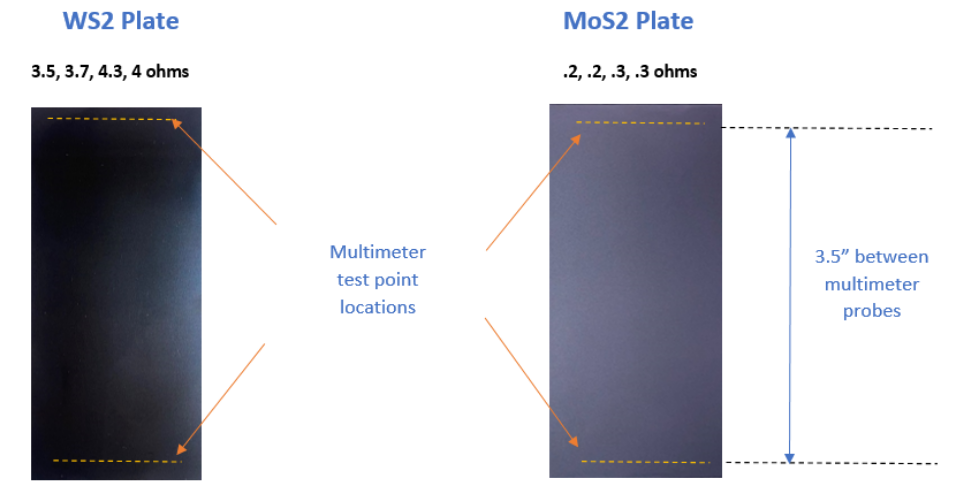
This basic testing was done as an interim experiment to answer customer questions about the conductive effects of our coatings. We are currently working on larger-scale testing in order to gather more extensive data about the differences in conductivity of WS2 and MoS2.
Additional Application Considerations
WS2 can be applied to any surface roughness, but for the coating to be fully effective a surface finish of 19 microinches or less is recommended; if the coating is applied to a part with a surface finish greater than this, the .5micron particle will sit in the valleys of the surface and reduce the effective contact area with the mating part. This will change the coating’s semiconductor properties. The same is true for molybdenum disulfide, except the maximum effective surface finish is 190 microinches.
There is a strong correlation between MoS2's conductivity and temperature. Despite the fact absolute values of resistivity or conductivity may vary, it is well established that with increasing temperature MoS2 demonstrates a gradual decrease in resistivity and increase in conductivity (Epshteyn & Risdon, 2010).
Another consideration is the effects of MoS2 and WS2 oxidation over time. MoS2 will oxidize into MoS3 and WS2 into WO3. The band gap of these materials is quite different and is approximately 2x greater than the disulfides. There is a finite shelf life of a coated WS2 and MoS2 coated part, but it is dependent on humidity and temperature.